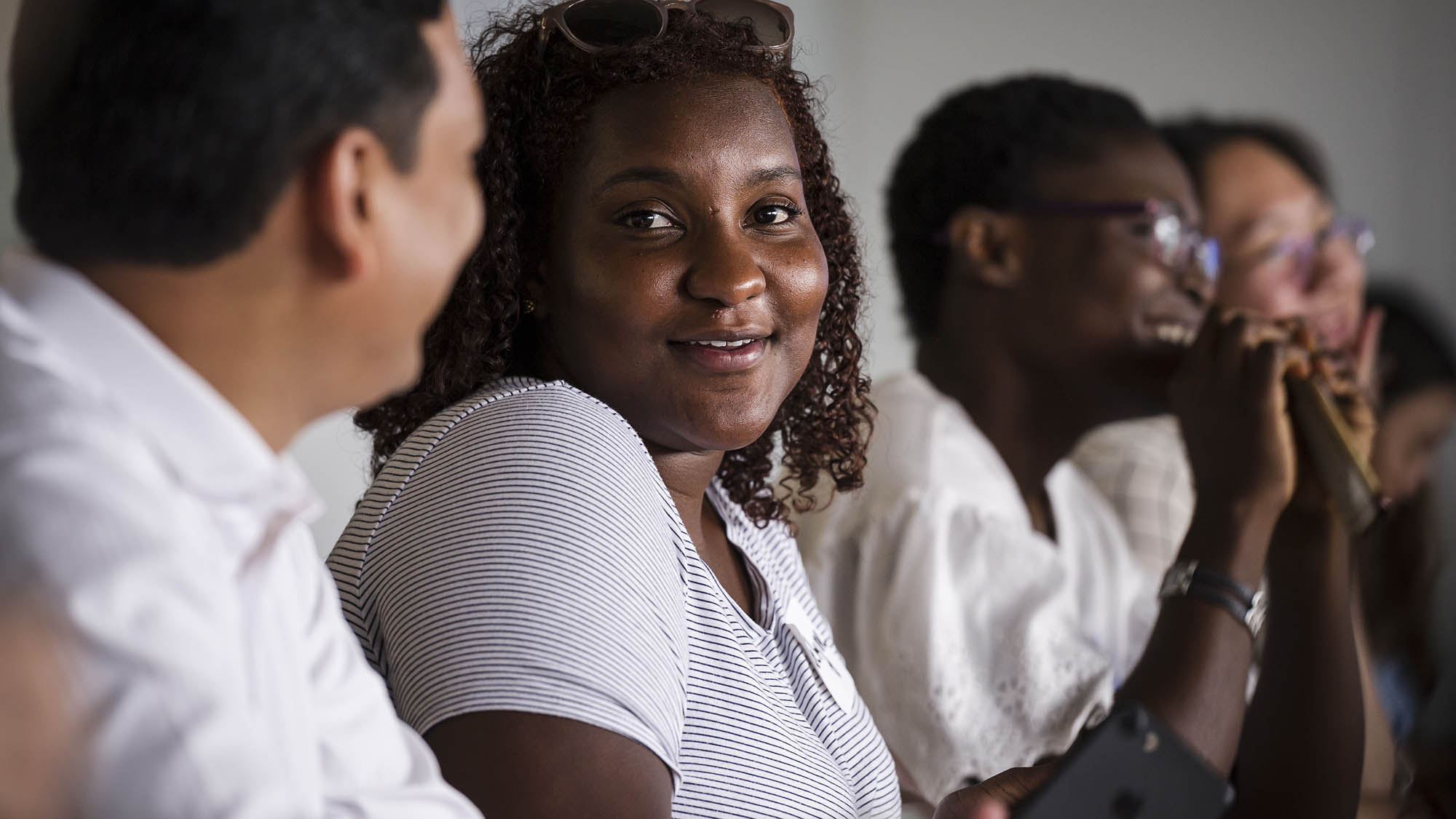
#doingjustice at OISE's Department of Social Justice Education
In this video series, we spoke with five students based in the Department of Social Justice Education (SJE) about their research, and the role of the department in their academic and personal growth.
Devonnia Miller
Devonnia Miller (she/her) is an SJE doctoral candidate. With over 15 years of experience in higher education administration, she has worked in various roles, including residence services, student life, academic and events coordination, and executive assistance. She was the president of the departmental student association for the 2024-25 academic year.
Harny Chan Lim
A Registered Early Childhood Educator, Harny Chan Lim (he/they) is a doctoral candidate at SJE. He has completed an Early Childhood Education (ECE) Diploma and Honours Bachelor's Child Development (BCD) Degree at Seneca College, and a Master of Arts in Early Childhood Studies (MA ECS) at Toronto Metropolitan University (TMU).
Kim Auger
Kimberly Auger is a doctoral candidate at SJE. She previously graduated with a Master of Teaching from OISE.
Willis Opondo
Willis Akala Opondo (he/him) is a Research Associate at the Toronto District School Board and a Ph.D. Candidate at the Department of Social Justice Education, OISE, at the University of Toronto. He has taught undergraduate sociology courses at Machakos University, Kenya and worked as a consultant urban sociologist for urban planning firms.
Heather Watts
Heather Watts (she/her) is Mohawk & Anishinaabe from Six Nations of the Grand River Territory. She graduated from Syracuse University with a degree in Inclusive Education, at Columbia University Teachers College with a degree in Literacy Coaching, and working as an elementary school teacher in New York City and in Rochester, NY.
Student Research Interests

Leanne Toshiko Simpson
EdD Student
Leanne’s work is inspired by a rich tradition of Japanese Canadian literary resistance and her longstanding teaching practice within disability arts. Her SSHRC-supported dissertation-in-practice explores how community-based, arts-informed spaces can contribute to building knowledge around the impact of the internment on Japanese Canadian wellbeing and identity. In offering intergenerational writing workshops through which the memory of internment is revisited and reshaped, Leanne’s project will develop knowledge through both the collaborative writing produced and the act of gathering itself. Through this work, wellbeing will be situated as a community endeavour amidst shifting histories of racial discrimination and settler colonialism in Canada and imperial legacies in Japan.
Keywords: Race & Citizenship Studies, Disability Arts, Creative Writing, Research Creation, Mental Health

Tshweu Moleme
PhD Student
Tshweu's research work is focused on areas such as labour, education, technology and the future of work, social change/justice, young workers, youth activism, and unions, in both Canada and the African continent, specifically Southern Africa. His work seeks to understand workplace dynamics, from knowledges and the transfer of knowledges within the workplace, generational and otherwise, to the power of work and workers, as well as ways in which change takes place within the workplace. His work also looks at young workers, their role and space-making (self-determination) within the area of work; the power of and challenges for young workers. Tshweu is also not only a labour activist and leader, but a keen researcher of unions, to see how they have or are evolving and their role in society.
Keywords: Labour, Unions, Social Change & Justice, Young Workers, Activism

Mayson Broccoli-Romanowska
MA student
Mayson explores how undergraduate social justice education can catalyze social change by linking critical reflection with action. Grounded in Critical Whiteness Studies and Critical Pedagogy Studies, her research examines how dominant oppressive systems—particularly white supremacy—are reproduced in institutions, and how they might be challenged through strategic, justice-oriented teaching and learning. She is interested in the pedagogical conditions that nurture accountability and solidarity, as well as designing learning experiences that foster sustained anti-racist and anti-colonial commitments beyond the classroom. Mayson brings experience in Canadian federal policy analysis supporting equity-seeking private businesses. Visit Mayson's LinkedIn.
Keywords: Critical Pedagogy Studies, Critical Whiteness Studies, Allyship & Activism, Praxis, Social Change

Jei Mikhail Bacuetes
MEd Student

Emelia Sandau
MA Student
Emelia’s SSHRC-supported research explores Drag Story Hour as a vibrant community event in Alberta, Canada. Inspired by her background in teaching and commitment to queer-inclusive pedagogy, Emelia’s work seeks to establish the value of these literacy events against a backdrop of anti-2SLGBTQ+ politics in Alberta. This research utilizes participant observation at Drag Story Hour, alongside interviews with attending parents and library facilitators to centre the joyful narratives of those who attend these events. Emelia’s work challenges misconceptions that portray Drag Story Hour as sites of controversy, conflict, and hate, instead, positioning them as spaces that cultivate community, solidarity, and joy. With her research she hopes to stand alongside communities working to protect Drag Story Hour as a joyful, affirming space for children, families, queer people, and all other participating community members.
Keywords: Education, Queer-Inclusive Pedagogy, Alberta Politics, Drag Story Hour, Queer Joy

Elena Tran
EdD Student
Drawing on feminist, decolonial, and critical theoretical frameworks, Elena's doctoral work examines how Vietnamese women immigrants in North America articulate agency, futurity, and belonging amid racialized, gendered, and political-economic constraints. Moving beyond damage-centered narratives, her scholarship foregrounds desire, aspirations, and everyday practices of self-making while remaining attentive to material and institutional conditions. She has published in international journals and regularly presents research on Vietnamese women, educators’ and students’ wellbeing, and ESL pedagogy at academic conferences. Elena is a higher education instructor, language practitioner, and founder of a community-based educational initiative focused on culturally responsive pedagogy and equitable access to learning for Vietnamese immigrant children and youth. Visit Elena's LinkedIn.

Jose Miguel (Miggy) Esteban
PhD Student
Miggy engages with dance practices and methods of research-creation to rethink the relations between disability studies and educational praxis. His work considers the obvious and not so obvious ways we are introduced to certain “ordinary” expectations of embodiment through narratives of normalcy that construct an ideal dancing body. Encountering these narratives as choreographic, he engages with the inspiration and repetition of gestures to reveal new possibilities for interpreting a return to our bodies, to our belonging within space, and to our movement in relation with one another. Centring the work of disabled dance/movement artists and practitioners, he hopes to discover new orientations to a critical and creative pedagogy of dance.
Keywords: Disability Studies, Dance Studies, Embodiment, Interpretive Methods, Research Creation

Sara Shivafard
EdD Student
Sara’s research and dissertation-in-practice is centred around sexual violence prevention in higher educational institutions with a specific focus on Ontario colleges. The research is guided by an interdisciplinary theoretical framework that emphasizes key elements of sexual violence prevention in higher education. This framework integrates policy analysis grounded in critical theories related to social differences such as race, gender, and power relations, with an understanding of the needs of various stakeholders. Her work considers the ways that colleges engage with prevention work, what is currently occurring in these spaces, and what can be done to improve prevention work. As a higher education professional in sexual violence prevention, Sara incorporates her work at OISE into practice. Visit Sara's LinkedIn.
Keywords: Sexual Violence Prevention, Prevention Work, Colleges, Ontario, Higher Education

Becky (Ying) Gu
MEd Student
Becky explores how narratives of citizenship, exile, and belonging shape the experiences of international students and displaced learners in higher education. Her research examines the visible and invisible pedagogical forces that influence social belonging within universities, investigating how cultural assumptions are reproduced in educational settings and how lived experiences can open new possibilities for understanding movement across borders. As Vice President of the International Student Association at OISE, she translates research into advocacy, working to foster genuine belonging for international students in Canada while developing a critical pedagogy that centres marginalized voices and values diverse forms of knowledge.
Keywords: Migration Studies, International Students, Higher Education, Community Building, Critical Pedagogy

Katherine Chen
MA Student
Katherine’s work explores sociocultural perspectives of Attention Deficit Hyperactivity Disorder (ADHD). She examines how dominant medicalized narratives of ADHD are constructed and experienced in educational settings. Her work focuses on the experiences of students, investigating how ADHD is noticed, interpreted, and made meaningful, highlighting the broader sociocultural, historical, and political contexts that shape these experiences. By expanding beyond individualized, medicalized views of ADHD, Katherine’s work examines the social and systemic factors that shape learning, aiming to contribute to more equitable educational approaches that consider the system as a whole.

Harina Baheta
MEd Student
Harina’s MEd research examines how emerging technologies, specifically artificial intelligence (AI), are reshaping learning opportunities and transforming the landscape of educational development. She is interested in how sustainable, community-driven approaches to AI can support overburdened teachers, address structural shortages, and imagine more equitable futures for African education. Harina brings experience working in the East African region, where she collaborated with educators to explore, develop and pilot AI-powered solutions responsive to local needs and grounded in community empowerment.
Keywords: Decolonial Technology Studies, Gender Equity in Education, Artificial Intelligence & Educational Justice, Critical Development Studies

Usha Sharma
PhD Student
Usha is a landed immigrant to Canada, is pursuing her doctoral studies. Her research in migration studies visualizes the deeply rooted global migration pattern, Western dream, and a hope of better life. It explores the tensions between capitalism and labour migration in the connection to remote district of Rolpa, Western Nepal, South Asia. Her research examines the neoliberal global order, mass displacement, structural exploitation, global inequalities, and highlights the underlying realities of labor migration. Her research aims to redirect the Eastern conception of West as economic heaven of material prosperity. It further demands the sustainable human development to achieve the social change, a capitalist society loyal to social responsibilities. She also engages with students’ affairs and currently serving as a Vice President for Social Justice Education Departmental Students’ Association, 2024-2026.

Nellie van Bruggen
EdD Student
Nellie (she/her) is an experienced adult educator and emerging scholar committed to advancing equity and social justice in educational spaces. Her research examines the experiences of international students at Ontario colleges through the lens of the education–migration nexus, analyzing how educational pathways intersect with immigration policy and labour‑market demands. Grounded in frameworks of transnationalism, neoliberal globalization, and settler colonialism, her work questions how Canada’s education and immigration systems continue to reproduce extractive relationships and uneven power dynamics. She also explores systemic racism and racialized gatekeeping, identifying how policy decisions and institutional practices disproportionately constrain racialized students. Central to her analysis is the concept of liminality and contested belonging, capturing the conditional, in‑between status international students navigate as they seek stability, opportunity, and recognition. Visit Nellie's LinkedIn.


